← Back to Senior Dignity
6 Best Shower Seats for Elderly Safety in 2026
Showering while standing is an act of faith. Faith that your balance will hold, faith that the soap won't make the floor treacherous, faith that your legs won't choose this particular moment to buckle. It's faith in a body that has been progressively betraying you for decades.
A shower seat removes the faith requirement. You sit. Water falls. You wash. You stand up when you're done, supported by a grab bar. No balancing, no rushing, no quiet terror that today might be the day the floor wins.
The CDC identifies bathing as the second most common activity during which bathroom falls occur, after toileting. The NIH National Institute on Aging specifically recommends shower seating as a primary fall prevention intervention, alongside grab bars and non-slip surfaces.
This guide covers six shower seats across four categories: wall-mounted folding, freestanding adjustable, premium teak, and bariatric. Each serves a different bathroom layout, body type, and budget.
Last updated: August 2026.
 ►
►
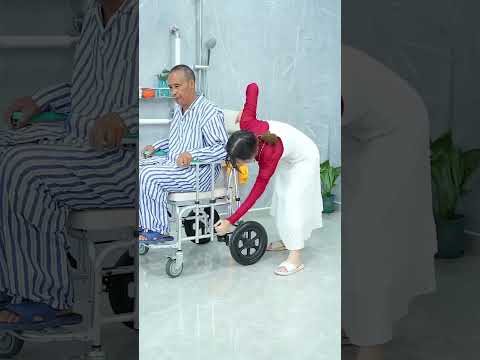
Watch: How Shower Chairs Improve Bathroom Safety: Must-Have for Seniors
1. Folding Teak Shower Seat — Best Overall
Best Overall
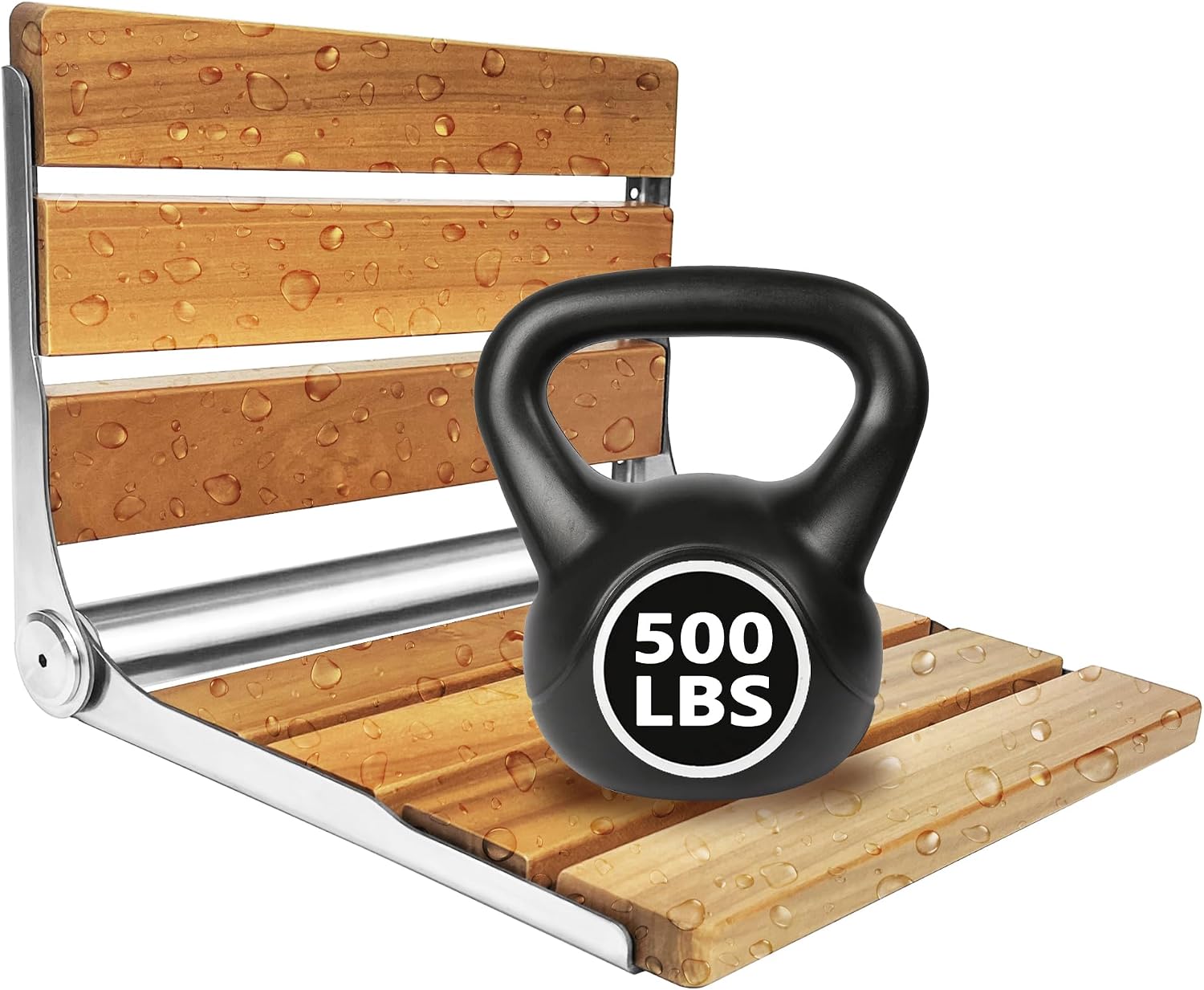
Folding Teak Shower Seat
Wall-mounted folding teak shower seat with integrated stainless steel grab bar — combines seating and support in one unit. Folds flat against wall when not in use.
Price: $130-160 | Rating: 4.5/5 | Mount: Wall-mounted, folding
SHOP
The Swiss Army knife of shower seats. It's a seat. It's a grab bar. It folds away. It looks like bathroom furniture, not medical equipment. For a household where the shower is used by multiple people (only one of whom needs the seat), the folding mechanism is essential — the seat protrudes less than two inches when folded, so it doesn't become an obstacle for standing users.
Teak is the optimal material here. Unlike plastic, which becomes slick with soap and develops mold in surface scratches, teak has natural oils that make it inherently water-resistant and slip-resistant. The wood develops a silver-gray patina over time that looks intentional — more "spa retreat" than "hospital bathroom." The stainless steel frame and mounting hardware resist corrosion in the humid shower environment indefinitely.
The integrated grab bar runs along the right side of the seat (left-side models are available), providing support during the most dangerous moment: the sit-to-stand transition at the end of the shower when the floor is wettest. This is also featured in our grab bar guide as the best combo option.
Installation note: Wall-mounted seats must be bolted into wall studs, not drywall. The seat plus a seated adult creates significant downward torque on the mounting brackets. If your shower walls are fiberglass or acrylic over drywall without stud backing, you need a freestanding seat instead.
2. Drive Medical Foldable Shower Bench — Best Budget Freestanding
Drive Medical Shower Bench
Drive Medical Foldable Shower Bench
Freestanding adjustable-height shower bench with aluminum frame and non-slip rubber feet — folds flat for storage and travel, supports up to 300 lbs.
Price: $35-50 | Rating: 4.4/5 | Weight Capacity: 300 lbs
SHOP
Drive Medical is the Honda Civic of medical equipment: unglamorous, reliable, everywhere. Their foldable shower bench is the model you'll find in half the hospital discharge rooms in America, and there's a reason — it works, it's cheap, and it doesn't break.
The aluminum frame is lightweight (under 5 lbs) but supports 300 lbs. The height adjusts in one-inch increments from 14 to 21 inches, accommodating users from 5'0" to 6'4". The seat surface is textured plastic with drainage holes — functional, not luxurious. Rubber feet grip wet surfaces adequately, though they're not as secure as a wall-mounted seat.
The folding mechanism is the standout feature for anyone who travels, visits relatives, or needs to store the seat when not in use. It collapses to about 4 inches thick and fits in a suitcase. For a $40 piece of equipment that provides bathroom safety anywhere you go, it's hard to beat.
3. Adjustable Shower Stool with Arms — Best for Transfer Support
Best for Transfer
Adjustable Shower Stool with Arms
Freestanding shower stool with integrated armrests — provides push-off support during sit-to-stand transitions, reducing the need for a separate grab bar.
Price: $55-70 | Rating: 4.3/5 | Weight Capacity: 300 lbs
SHOP
The hardest part of using a shower seat isn't sitting down — it's standing up. The sit-to-stand transition requires leg strength, core stability, and often one hand on a wall or bar for balance. If the shower doesn't have a wall-mounted grab bar (and many don't), the user has nothing to push against except wet tile — which is how falls happen.
This stool solves it with built-in armrests. The user pushes down on the arms to stand, transferring load through the arms to the stool legs to the floor. No wall bar required. It's a self-contained support system that works in any shower, regardless of wall construction or stud placement.
The trade-off versus a backless bench: the arms add width, so the stool requires a shower at least 24 inches wide. Measure your shower before ordering. The stool also doesn't fold — the arms are fixed, so storage is more awkward than the Drive Medical bench above.
4. Premium Teak Wall-Mount Shower Seat — Best for Small Showers
Space Saver
Premium Teak Wall-Mount Shower Seat
Solid teak corner-mounted shower seat that folds flat against the wall — designed for small showers and stall enclosures where floor space is at a premium.
Price: $100-130 | Rating: 4.6/5 | Mount: Wall-mounted, corner
SHOP
Not every bathroom has a 5x7 shower stall with room for a freestanding bench. Many older homes — the ones seniors are most likely to be aging in place in — have 36-inch stall showers or combination tub-showers where floor space is measured in inches.
A corner-mounted teak seat uses the dead space where two walls meet, which is structurally the strongest part of the shower (studs on both sides) and functionally the least used (nobody stands in the corner). The seat extends about 16 inches from the wall when deployed and folds to under 3 inches when stowed.
The solid teak construction (not slats) means there are no gaps for small items to fall through and no crevices where mold can establish. The seat is sanded smooth but not sealed — teak's natural oils provide water resistance without chemical treatment.
5. Bariatric Shower Chair with Backrest — Best for Higher Weight
Heavy Duty
Bariatric Shower Chair with Backrest
Heavy-duty shower chair with wide seat, full backrest, and reinforced frame — supports up to 500 lbs for bariatric users who need stable shower seating.
Price: $80-120 | Rating: 4.4/5 | Weight Capacity: 500 lbs
SHOP
Most shower seats are rated for 250-300 lbs. For users above that weight — and the CDC reports that 42% of adults 60+ are clinically obese — standard seats are a failure waiting to happen. A seat that collapses under load doesn't just cause a fall; it causes a fall onto broken plastic and metal, with a body that's already at higher risk for injury.
The bariatric chair is built different. The frame uses thicker-gauge aluminum (1.5mm wall vs 1.0mm on standard chairs), the seat is blow-molded plastic rated for 500 lbs, and the base is wider (24 inches vs 18) for stability. The backrest provides lumbar support that backless seats can't — important for users who tire quickly and lean back during showers.
The trade-off is footprint. This chair needs a shower at least 30 inches wide, and it doesn't fold. It lives in the shower permanently. But for the user who needs it, the alternative — no seat, standing unsafely — is worse.
6. Compact Corner Shower Stool — Best for Tub-Shower Combos
Compact Corner Shower Stool
Compact Corner Shower Stool
Low-profile corner stool designed for bathtub-shower combinations — fits in the narrow end of a standard tub where full-size benches can't go.
Price: $30-45 | Rating: 4.5/5 | Weight Capacity: 250 lbs
SHOP
The bathtub-shower combo is the most common bathroom fixture in American homes built before 2000 — which is also the housing stock most seniors are aging in place in. The problem: a tub-shower combo gives you roughly 30 inches of width and 55 inches of length, with a sloped back end that tapers to 24 inches. A standard shower bench doesn't fit without blocking the faucet controls.
The corner stool is shaped to fit the narrow end of the tub — triangular or trapezoidal, with two legs on the wide side and one or two on the narrow side. It provides a perch (not a full seat) that's enough for someone who needs to sit during part of the shower but can stand for the rest. At under $40 and 250 lb capacity, it's the entry-level option for someone who's just starting to feel unsteady but isn't ready for a full bench.
This is the training-wheels shower seat. It says: "I'm being proactive about safety" rather than "I can't stand anymore." For the senior who's resisting the idea of a shower seat, this is the one that gets their foot in the door — literally and figuratively.
How to Choose a Shower Seat
Step 1: Measure Your Shower
Width, depth, and the distance from the floor to where the showerhead reaches. A seat that's too wide blocks the faucet or the door. A seat that's too tall puts the showerhead at chest level. Bring a tape measure to the bathroom before you buy anything.
Step 2: Check Your Walls
Wall-mounted seats require studs. If you have fiberglass shower walls, tile over drywall without backing, or can't locate studs, choose a freestanding model. The Moen SecureMount system (from our grab bar guide) can also work for wall-mounted seats if you're set on the wall-mount option.
Step 3: Match Weight Capacity
The seat's weight rating should exceed the user's weight by at least 50 lbs. A 250 lb-rated seat for a 240 lb person has no safety margin. A 300 lb-rated seat for a 200 lb person has plenty. When in doubt, go higher.
Step 4: Consider the Transfer
How will the user get in and out of the seat? If they need arm support to stand, choose a model with armrests or position a grab bar adjacent to the seat. If they can stand independently but need to rest mid-shower, a simple stool is sufficient.
Step 5: Address the Psychological Barrier
Introduce the seat as an upgrade, not a concession. "I found this great teak shower bench" lands better than "I bought you a shower chair because I'm worried about you falling." The teak models are particularly good for this — they look like design choices, not medical devices.
FAQ
Q: What type of shower seat is safest for elderly?
A: Wall-mounted folding seats bolted into wall studs are safest because they can't tip or slide. Among freestanding seats, models with four legs, rubber non-slip feet, and armrests provide the most stability.
Q: How high should a shower seat be for a senior?
A: Seat height should match the user's knee height when standing, typically 17-19 inches. Feet should rest flat on the floor when seated, with knees at roughly 90 degrees. Adjustable-height seats accommodate 14-21 inch ranges.
Q: Are teak shower seats better than plastic?
A: Teak is superior for shower use: it resists water damage naturally, doesn't become slippery when wet, maintains temperature (doesn't feel cold), and develops an attractive patina. Plastic is cheaper and lighter but can become slick and develop mold.
Q: Does Medicare cover shower seats?
A: Medicare Part B does not cover shower seats, classifying them as bathroom safety equipment rather than durable medical equipment. Some Medicare Advantage plans offer bathroom safety benefits. FSA/HSA funds may be eligible with a doctor's letter.
The Bottom Line
Every shower taken while standing is a calculated risk. Every shower taken while seated is not. The math is that simple, and the solution is that simple — a seat, properly installed, that supports the user's weight through every minute of the shower.
My recommendation by scenario:
- Standard shower stall with stud walls: Folding teak seat with grab bar ($130-160) — best all-around option
- Tub-shower combo in an older home: Compact corner stool ($30-45) — fits where nothing else does
- Temporary or travel use: Drive Medical foldable bench ($35-50) — takes it anywhere
- Higher weight (250+ lbs): Bariatric chair with backrest ($80-120) — built for the load
Pair any seat with a grab bar for the sit-to-stand transition, and you've addressed the two most dangerous moments in the most dangerous room. For the full bathroom safety product range, visit our Senior Dignity hub.
Reviewed by Adele, Founder & Senior Gift Curator. Last updated August 2026. Products verified via live Amazon search. This article contains affiliate links and references CDC and NIH data. See our privacy policy for disclosure details.
Watch & Learn: Video Guides
 ►
►
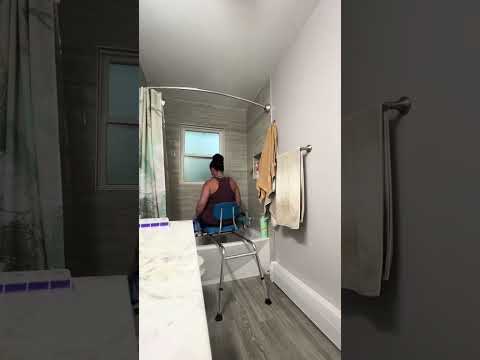
Watch: Best Shower Seats for Elderly Review
 ►
►
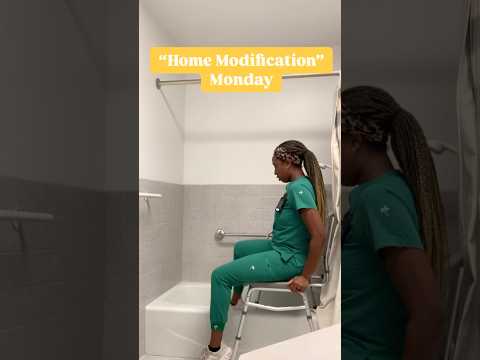
Watch: Shower Chair Safety Guide for Seniors