
MGMini Medical Alert Device
Compact SOS button with 24/7 professional monitoring. Subscription required. Waterproof, GPS-enabled, and small enough to wear as a pendant or clip to a belt.
Price: ~$63.99 | Rating: 3.8/5 (285 reviews)
The promise of a medical alert system is simple: press a button, and help comes. The reality is more complicated — because the button only works if it's being worn, the battery is charged, the cellular connection is live, and the monitoring center can pinpoint your location. Get any of those wrong, and the button becomes a $30/month talisman that gives the family peace of mind without actually protecting the senior.
The CDC reports that 1 in 4 adults 65+ falls each year, and NIH research shows that rapid response to a fall significantly improves outcomes — particularly for hip fractures, where the "golden hour" of response time determines whether surgery is elective or emergent. A senior who falls and lies on the floor for 6 hours has a dramatically different prognosis than one who falls and receives help in 6 minutes.
The medical alert market has also evolved beyond the "I've fallen and I can't get up" pendant. Modern systems include GPS tracking, automatic fall detection, smartwatch integration, caregiver mobile apps, and wellness check-in features. This guide compares seven systems across three categories: home-based, mobile, and wearable.
Important: This article covers systems and services, not individual Amazon products. Most medical alert systems require a monthly subscription and are purchased directly from the provider, not through Amazon. We've included Amazon-available devices where applicable.
Last updated: August 2026.
 ►
►
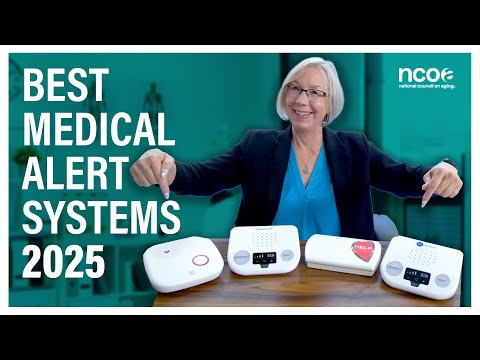
Watch: Best Medical Alert Systems: Our Top 5 Picks for Older Adults!
Compact SOS button with 24/7 professional monitoring. Subscription required. Waterproof, GPS-enabled, and small enough to wear as a pendant or clip to a belt.
Price: ~$63.99 | Rating: 3.8/5 (285 reviews)
Medical Guardian earns the top spot for one reason: the 1,400-foot range. Most home-based systems offer 400-600 feet, which covers the house but not the yard, driveway, or mailbox. Medical Guardian's range means the help button works while getting the mail, gardening, or walking to the car — the outdoor scenarios where falls are most likely and least likely to be witnessed.
The base station connects via cellular (no landline required) and includes a 32-hour backup battery for power outages. The pendant is showerproof (IP67 rated), which matters because bathroom falls are the #1 scenario — a pendant that can't get wet is a pendant that's sitting on the bathroom counter when the fall happens.
The monitoring center is UL-listed and CSAA Five Diamond certified, meaning it meets the highest industry standards for operator training and response time. Average response time is under 30 seconds from button press to operator voice contact.
Fall detection is a $10/month add-on. It uses accelerometers to detect the fall pattern and auto-calls the monitoring center if the user doesn't cancel within 30 seconds. False positives exist (about 15% of activations), but the alternative — a fall where the user is unconscious and can't press the button — makes the false alarm cost acceptable.

All-in-one mobile medical alert with built-in GPS and cellular — works anywhere with cell coverage. No base station needed. Two-way voice directly from the pendant.
Price: ~$74.99 | Rating: 4.3/5 (595 reviews)
Home-based systems only protect you at home. For the senior who still drives, walks in the neighborhood, shops, or attends social events, a mobile system is the only option that provides protection outside the 1,400-foot radius.
The Lively Mobile Plus is a self-contained pendant with a built-in cellular radio (AT&T network), GPS locator, and two-way speaker. When the button is pressed, the pendant connects directly to the monitoring center — no base station, no phone needed. The GPS transmits the user's location to the monitoring center, which is critical for situations where the user can't speak or doesn't know their location.
Battery life is 5 days per charge, with a low-battery alert that notifies both the user and the caregiver app when charging is needed. The pendant is showerproof but not swim-proof. Fall detection is included in the base price (not a paid add-on), which makes the total cost competitive with systems that charge extra for it.
The caregiver app (Lively Link) provides location tracking, battery status, and activity monitoring — useful for family members who want to confirm the pendant is being worn and charged without calling to check.

Budget-friendly home medical alert starting at $19.95/month — landline or cellular connection. 1,000-foot range. Optional fall detection at $10/month.
Price: ~$74.95 | Rating: 4.0/5 (97 reviews)
At $19.95/month, Bay Alarm is the most affordable reputable monitoring service on the market. The base price includes the equipment (no upfront fee), a base station, and a wearable help button with a 1,000-foot range — better than most competitors in this price range.
The trade-off is features. Bay Alarm's base system uses a landline connection (a cellular upgrade is available for an additional $10/month). The pendant is showerproof but bulkier than the Medical Guardian's. The monitoring center is UL-listed but not CSAA Five Diamond certified (it's CSAA Five Diamond pending).
For a senior on a fixed income where $10/month difference matters ($240/year), Bay Alarm provides the essential service — button press connects to a live operator who dispatches help — without the premium features. Fall detection is available as a $10/month add-on, bringing the total to $29.95/month.

The original medical alert brand — 35+ years in business, 600-foot range, wall button included. Requires a 3-year contract with significant cancellation fees.
Price: ~$17.98 | Rating: 4.7/5 (735 reviews)
Life Alert is here because the user asked, not because it's the best value. It's the most recognized brand in medical alerts — the "I've fallen and I can't get up" company. That recognition matters: a senior who recognizes the brand is more likely to wear the pendant consistently, and consistent wear is the single most important factor in medical alert effectiveness.
The system includes a base station, a wearable pendant, and a wall button (mounted in the bathroom, where falls are most common). The 600-foot range is adequate for most apartments and smaller homes. The monitoring center is staffed 24/7 with dispatchers who have access to the user's medical history, emergency contacts, and preferred hospital.
The reason Life Alert ranks fourth instead of first is the contract: a 3-year commitment with cancellation fees that can exceed $1,000. If the user's needs change (moving to assisted living, switching to a mobile system, or unfortunately passing away), the contract obligation continues. For month-to-month flexibility, Medical Guardian and Bay Alarm are superior.

Voice-activated medical alert system with built-in smart speaker — call for help by voice without pressing a button. Air quality sensor, motion tracking, and caregiver app included.
Price: ~$69.99 | Rating: 4.6/5 (17 reviews)
The problem with every other system on this list: you have to press a button. If the pendant is on the nightstand instead of around the neck, if the user's hands are incapacitated by a stroke, or if the user is confused and doesn't understand they need to press the button — the system fails silently.
Aloe Care solves this with voice activation. The base station is a smart speaker that listens for a wake phrase ("Call for help") and connects to the monitoring center without any button press. The user can be across the room from the pendant and still summon help by voice. This is particularly valuable for nighttime falls, where the pendant may be on the nightstand but the user is on the floor and can't reach it.
The system also includes motion tracking — it detects when the user has been inactive for an unusual period and sends an alert to the caregiver app. If the user typically moves around the house between 7 AM and 9 PM but the sensor detects no motion for 4 hours during that window, the caregiver receives a notification. This catches the "fallen and can't reach the button" scenario that button-only systems miss entirely.
The air quality sensor (temperature, humidity, CO2) is a bonus feature that monitors environmental conditions — useful for seniors with respiratory conditions whose symptoms worsen in poor air quality.

Wall-mounted pull-string alert system — no pendant or wearable required. Pull cords in bathroom, bedroom, and hallway. Voice activation from any room with a base unit.
Price: ~$89.00 | Rating: 4.0/5 (255 reviews)
The hardest part of medical alert compliance isn't the technology — it's getting the senior to actually wear the pendant. Resistance to "wearing the button" is the #1 reason medical alert systems fail. The pendant is stigmatized (it looks like medical equipment), uncomfortable (it bounces when walking), or forgotten (taken off for a shower and not put back on).
GetSafe eliminates the wearable entirely. The system uses wall-mounted pull cords installed at key fall-risk locations: beside the bed, in the bathroom, and along the hallway. Each cord hangs to within arm's reach of floor level — so a senior who has fallen can reach up and pull the cord from the ground. Voice activation is also available from the base unit and satellite units.
The system starts at $79 for the starter kit (1 base unit, 2 pull-cord wall buttons) and $24.95/month for monitoring. Additional wall buttons are $12 each. A typical 3-bedroom home needs 4-5 wall units for full coverage, bringing the equipment total to around $130.
The limitation: this is a home-only system. There's no mobile/GPS component. For a senior who doesn't leave the house independently, this is fine. For one who still drives or walks in the neighborhood, pair it with a mobile system like the Lively Mobile Plus.

Smartwatch with built-in fall detection and emergency SOS — calls 911 automatically after a detected fall. No monthly monitoring fee. GPS, heart rate, ECG, and medication reminders.
Price: ~$219.00 | Rating: 4.7/5 (4,194 reviews)
The Apple Watch isn't a medical alert system in the traditional sense — it doesn't connect to a monitoring center, and it doesn't have a live operator on the other end. What it does have is fall detection that calls 911 directly, which is free, immediate, and doesn't require a monthly subscription.
When the watch detects a fall (using the accelerometer/gyroscope pattern), it displays an alert. If the user doesn't dismiss it within 60 seconds, the watch automatically calls 911 and sends a text message to designated emergency contacts with the user's GPS location. The user can also press and hold the side button to manually call 911.
For a tech-comfortable senior who already has an iPhone, the Apple Watch is a compelling alternative to a traditional medical alert. The upfront cost is higher ($249 vs. $0-50 for traditional systems), but the monthly cost is $0 vs. $20-50/month. Over 2 years, the Apple Watch is cheaper than any monitoring service on this list.
The limitations: it requires an iPhone (Android users are out of luck), it needs to be charged nightly (18-hour battery), and it doesn't provide the two-way voice reassurance of a monitoring center operator. It's a technology solution, not a human one. For a senior who values independence and technology over the hand-holding of a monitoring service, it's ideal. For a senior who would be overwhelmed by a smartwatch interface, stick with a pendant.
Does the senior leave the house independently? If yes, a mobile/GPS system (Lively Mobile Plus) is mandatory — home systems don't work outside range. If no, a home-based system (Medical Guardian) provides better range and battery life for the price.
Will the senior actually wear the pendant? If resistance is high (and it usually is), consider a no-wearable system (GetSafe) or a smartwatch (Apple Watch) that doesn't carry the same stigma. A pendant on the nightstand is $30/month of false security.
For high fall risk (history of falls, balance disorders, cognitive impairment), automatic fall detection is non-negotiable. If the user falls and can't press the button, the system is useless without auto-detection. For lower fall risk, a button-press system is sufficient.
Monthly fees aren't the only cost. Factor in equipment fees, activation fees, fall detection add-ons, and contract cancellation penalties. A $20/month system with a 3-year contract costs more than a $30/month month-to-month system if the user's needs change within that period.
A medical alert system is the safety net — it activates after a fall. To prevent the fall in the first place, pair it with grab bars, night lights, bed rails, reacher grabbers, and non-slip slippers. See our Aging in Place Guide for the complete prevention system.
Q: How much do medical alert systems cost per month?
A: $19.95 to $49.95/month. Basic home systems start around $20. Mobile GPS systems run $25-35. Fall detection adds $5-10/month. The Apple Watch is a one-time $249 purchase with $0/month.
Q: Does Medicare cover medical alert systems?
A: Original Medicare does not cover them. Some Medicare Advantage plans offer discounts. Medicaid waivers vary by state. VA benefits may cover eligible veterans.
Q: How does automatic fall detection work?
A: Accelerometers detect the fall pattern (sudden downward acceleration followed by immobility). If the user doesn't cancel within 30-60 seconds, the device auto-calls the monitoring center or 911. False positives occur in 10-20% of detections.
Q: What is the range of a home-based system?
A: 400-1,400 feet from the base station, depending on the model. Medical Guardian has the longest range at 1,400 feet. Mobile systems work anywhere with cell coverage.
A medical alert system is the last line of defense — it doesn't prevent the fall, it manages the response. The best system is the one the senior will actually use consistently, which means matching the technology to their lifestyle, comfort with devices, and willingness to wear a pendant.
My recommendations:
For the complete fall prevention catalog — including bed rails, shower seats, and grab bars — visit our Senior Dignity hub.
Reviewed by Adele, Founder & Senior Gift Curator. Last updated August 2026. Some systems are purchased directly from providers, not Amazon. This article contains affiliate links and references NIH and CDC research. See our privacy policy for disclosure details.
 ►
►
Watch: Medical Alert System Comparison
 ►
►
Watch: Medical Alert Devices Review